
Fruit · Food guide
Can dogs eat plums?
Yes, pitted and in small amounts. The pit, stem and leaves never belong in the bowl.
Not a substitute for advice from your vetUpdated Oct 10, 2026
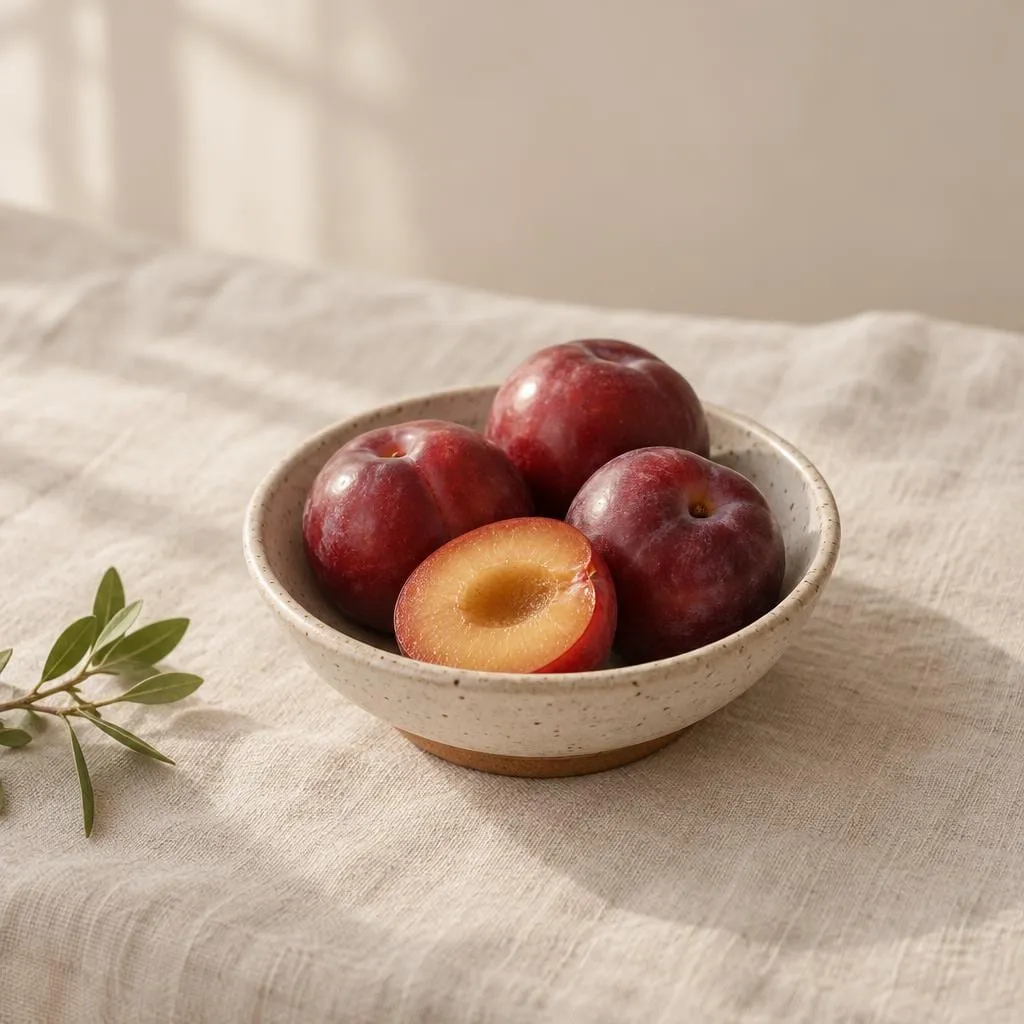 AI image
How much plums can your dog have?
Rule of thumb: snacks make up no more than 10% of daily calories.
Set your dog's ideal weight.
As a snack, no more than a day. That's .
Daily energy needs calculated the same way as in the Kahuno app.
The 10% limit applies to snacks and treats according to WSAVA, not to meals.Yellow: this amount is only a guideline. Keep the restrictions below in mind.
What's in plums?
Composition per 100 g
Energy and macros
| Energy | 48 kcal |
| Protein | 0.3 g |
| Fat | 0.2 g |
| Carbohydrates | 10.7 g |
| Fiber | 1.7 g |
| Water | 87.1 g |
Minerals
| Calcium | 8 mg |
| Phosphorus | 16 mg |
| Ca : P ⓘ | 0.5 : 1 |
| Sodium | 1 mg |
| Potassium | 172 mg |
| Magnesium | 7 mg |
| Iron | 0.2 mg |
| Zinc | 0.1 mg |
| Copper | 65 µg |
| Iodine | – |
Vitamins and fatty acids
| Vitamin A | 51 µg RE |
| Vitamin D | 0 µg |
| Vitamin E | 0.3 mg |
| Linoleic acid | 0.05 g |
| Omega-3 | 0.03 g |
| EPA | 0 g |
| DHA | 0 g |
Source: Max Rubner-Institut. (2025). Bundeslebensmittelschlüssel (BLS), Version 4.0 — Deutsche Nährstoffdatenbank. doi.org
Composition per 100 g
Energy and macros
| Energy | 57 kcal |
| Protein | 0.4 g |
| Fat | 0.2 g |
| Carbohydrates | 12.6 g |
| Fiber | 2 g |
| Water | 84.5 g |
Minerals
| Calcium | 9 mg |
| Phosphorus | 19 mg |
| Ca : P ⓘ | 0.47 : 1 |
| Sodium | 1 mg |
| Potassium | 192 mg |
| Magnesium | 8 mg |
| Iron | 0.2 mg |
| Zinc | 0.1 mg |
| Copper | 73 µg |
| Iodine | 1 µg |
Vitamins and fatty acids
| Vitamin A | 49 µg RE |
| Vitamin D | 0 µg |
| Vitamin E | 0.3 mg |
| Linoleic acid | 0.06 g |
| Omega-3 | 0.04 g |
| EPA | 0 g |
| DHA | 0 g |
Source: Max Rubner-Institut. (2025). Bundeslebensmittelschlüssel (BLS), Version 4.0 — Deutsche Nährstoffdatenbank. doi.org
Key facts at a glance
What to watch out for
- The pit, stem and leaves contain compounds that release cyanide; the flesh contains only a little
- Chewed-up pits are more dangerous than ones swallowed whole
- Stone fruit pits are among the foreign objects vets remove from dogs by endoscopy or surgery
- No prunes: very high in sugar and sorbitol
- No plum cake, no sweetened stewed plums
How to feed plums the right way
- 1Only ripe fruit, washed and pitted
- 2Start with a small piece and keep an eye on the poop
- 3Pick up fallen fruit in the yard before your dog finds it
Safety rating for each dog
Can Romeo handle plums?
This page applies to dogs in general. In Kahuno, you add intolerances to the dog profile, and every ingredient gets a color-coded dot when you log it, checked for your dog specifically. Whoever feeds the dog in your household sees it right away.
Frequently asked questions
Are plums and damson plums the same thing?
Botanically, yes. According to the German Environment Agency (Umweltbundesamt), the common plum and the Zwetschge (damson plum) are two names for the same subspecies, Prunus domestica subsp. domestica. In everyday use, the round, softer fruits are usually called plums and the oval, firmer ones damson plums. For dogs, the same rules apply to both.
How many plums can my dog eat?
As a snack, the 10% rule applies: treats make up no more than 10% of daily calories. The calculator above shows the upper limit for your dog's weight. Plums contain fiber and sorbitol, which have a laxative effect in people. This hasn't been studied in dogs, so start with a small piece.
My dog swallowed a plum pit. What should I do?
Call your vet and tell them how big your dog is and how many pits it got. A pit swallowed whole releases little cyanide, but it can get stuck in the stomach or intestines. Watch for vomiting, belly pain, no poop and lethargy. Chewed-up pits are more concerning because of the cyanide.
Can dogs eat prunes?
Better not. Prunes contain 11 to 15 g of the sugar alcohol sorbitol per 100 g, plus a lot of sugar. In people, the sorbitol is considered the reason for their laxative effect.
Other people also wanted to know
All foods Damson plumIn moderationYes, pitted and in small amounts. Damson plums have a laxative effect.48 kcal / 100 gMore →
 CherryIn moderationOnly pitted. The flesh is safe, but the pits, stems and leaves contain amygdalin, which releases cyanide.70 kcal / 100 gMore →
 PeachIn moderationThe flesh, yes. The pit, never. It contains amygdalin and can block the intestines.39 kcal / 100 gMore →
Sources
- ASPCA Animal Poison Control: Plum, Felder „Toxic Principles" und „Clinical Signs", Stiele, Blätter und Kerne. Abgerufen am 10.10.2026.
- Merck Veterinary Manual: Cyanide Poisoning in Animals, Abschnitt „Plants in Etiology of Cyanide Poisoning", Kerne und Blätter gegenüber Fruchtfleisch, Zerbeißen. Abgerufen am 10.10.2026.
- Di Palma et al. 2022, Animals: Endoscopic and Surgical Removal of Gastrointestinal Foreign Bodies in Dogs (72 Fälle), Abstract, Pfirsichkerne als 7 % der Fremdkörper.
- Gill et al. 2019, International Journal of Food Sciences and Nutrition: Nutrient, fibre, sorbitol and chlorogenic acid content of prunes, Abstract, Sorbit in Trockenpflaumen 11,2 bis 15,5 g je 100 g.
- Umweltbundesamt, Glossar: Pflaumen, Gewöhnliche Pflaume und Zwetschge als Namen für Prunus domestica subsp. domestica.